
Racel Bianca Lantano Gas-4

The origins of smallpox have been lost in prehistory but research suggests it first appeared around 10,000 BC. Telltale pockmarks adorn the the mummified remains of the great Egyptian Pharaoh Ramses V (dated at 1156 BC) and the disease is described in ancient Sanskrit texts.
Smallpox is caused by the variola virus. Humans are the only natural hosts of smallpox and transmission depends upon direct contact with an infected person or infected bodily fluids, contaminated bedding or clothing. Airborne transmission is rare, although is more likely in enclosed settings such as buildings, buses, and trains.
An incubation period of up to 17 days (average 12 to 14 days) follows exposure to the virus and people are not contagious at this time. Initial symptoms are generally flu-like before small spots start to develop inside the mouth and on the tongue. Within 24 hours a rash starts on the face and quickly spreads before evolving into raised volcano-like pustules filled with a thick, opaque fluid. These pustules may take up to two weeks to scab over, leaving marks on the skin that eventually become pitted scars.
Yearly Death Rate In The 1800’s Was 400,000 From Smallpox
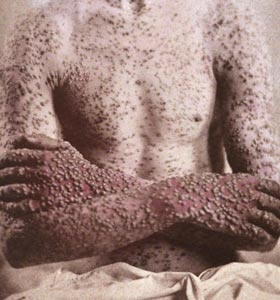
During the 18th century, over 400,000 people died annually in Europe from smallpox. Overall fatality rates were around 30%; however, rates were much higher in infants (80-98%), and one third of all survivors went blind.
One thing was obvious among survivors of the disease – they never caught it again. This observation started the human fight against smallpox. First came variolation which involved blowing dried smallpox scabs up a person’s nose, deliberately infecting them with the disease.
Inoculation used a lancet to transfer the contents of a smallpox pustule under the skin of a non-immune person. It was a bit risky – some people developed smallpox from the procedure or contracted other diseases such as tuberculosis or syphilis. But fatality rates associated with inoculation were 10 times lower than those associated with naturally occurring smallpox.
In the late 1700s, at least two people acted on the observation that dairymaids who had cowpox, never contracted smallpox. In 1774, Benjamin Jesty used material from cows with cowpox to inoculate his wife and two young sons. In 1796, Dr Edward Jenner used matter from a cowpox-infected young dairy maid to protect an 8-year old boy. Two months later he inoculated the same boy with smallpox, and no disease developed. Dr Jenner’s work paved the way for vaccination as we know it today.
 DEADLY DISEASES
Leave a comment